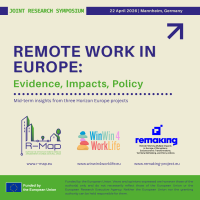
 On 22 April 2026, the R-Map Project co-organise the “Remote Work in Europe: Evidence, Impacts, Policy” symposium together with its sister projects WinWin4WorkLife and REMAKING. The event will take place at the ZEW – Leibniz Centre for European Economic Research in Mannheim, Germany, with hybrid participation available for both in-person and online audiences. Bringing together leading researchers from across Europe, the symposium will present mid-term findings from three Horizon Europe projects exploring how remote work is reshaping economies, organisations, and everyday life. The event will offer a comprehensive evidence-based discussion on the future of work in Europe, addressing its economic, social, spatial, and policy dimensions.
A shared research agenda on remote work
The symposium opens with a joint framing session introducing the three projects and their shared ambition, to better understand how remote work transforms labour markets, organisations, and territories across Europe. The opening discussion sets the stage for a coordinated research agenda, highlighting how each project contributes complementary perspectives on the evolving remote work landscape.
Understanding the impacts of remote work
The first thematic session, “Framing Remote Work Impacts”, examines the key concepts, models, and societal drivers that shape both the adoption and consequences of remote work. It brings together complementary perspectives, ranging from conceptual frameworks linking employer and employee dynamics, to analytical models that map the factors influencing remote work outcomes, and empirical insights into evolving trends across Europe.
This is followed by the session “Who Offers Remote Work – and Why?”, which explores business strategies, productivity, and organisational change associated with remote work adoption. The contributions examine why and how firms implement remote work practices, and what implications these have for employee productivity, creativity, and well-being from an employer perspective. They further investigate how remote work shapes wage-setting, influences firms’ location decisions, and relates to innovation and local development dynamics. Together, these insights highlight the organisational and economic rationales underpinning remote work adoption across Europe.
Remote work from the employee perspective
In the afternoon, the symposium turns to the employee perspective with the session “Who Demands Remote Work – and Why?”. It examines how remote work shapes workers’ everyday lives, drawing on survey data, cross-border dynamics, and comparative case studies. The session highlights diverse experiences across social groups, occupations, and national contexts, offering a nuanced view of its varied social outcomes.
Spatial and regional transformations
Another key theme of the symposium is the “Where Remote Work Happens” session, focusing on the spatial and regional impacts of remote work. It examines how teleworking reshapes mobility patterns, regional development, and urban–rural dynamics, including the redistribution of economic activity between metropolitan and inner areas. The session also explores simulation approaches to assess environmental and spatial impacts, as well as digital tools for visualising regional patterns. A key highlight is the R-Map visualization platform, which visualizes regional patterns and spatial impacts of remote work to support evidence-based exploration and comparison.
Policy perspectives and future directions
The final part of the symposium is dedicated to policy perspectives and future directions emerging from the three projects. This session brings together policy briefs and comparative reflections, followed by an interactive discussion on synergies between research findings and policy needs. The symposium concludes with a shared discussion on how research can better inform European policy responses to the ongoing transformation of work.
Register & Join us on the symposium
The event is free of charge and open to researchers, policymakers, practitioners, and the wider public. Participation is possible both on-site in Mannheim and online, ensuring broad accessibility and engagement. The symposium represents a unique opportunity to engage with cutting-edge European research on remote work and to contribute to a growing interdisciplinary dialogue on the future of work in Europe.
📍Download the full agenda here: https://www.zew.de/fileadmin/FTP/veranstaltungen/WW4WL_Webinar2026_Programme.pdf
👉Register here: https://eveeno.com/research_symposium